Project 01 / 07 / shipped
Tally
A small bank on a double-entry ledger that never loses or doubles a cent, even when the network fails mid-payment.
From the write-up
Tally is a small bank that can never lose or double a cent. Every transfer is written as two entries that cancel out, a payment retried after a dropped connection lands exactly once, every balance can be rebuilt from scratch to prove nothing leaked, and suspicious transfers are flagged after they land with the evidence attached.
Headline numbers / 2
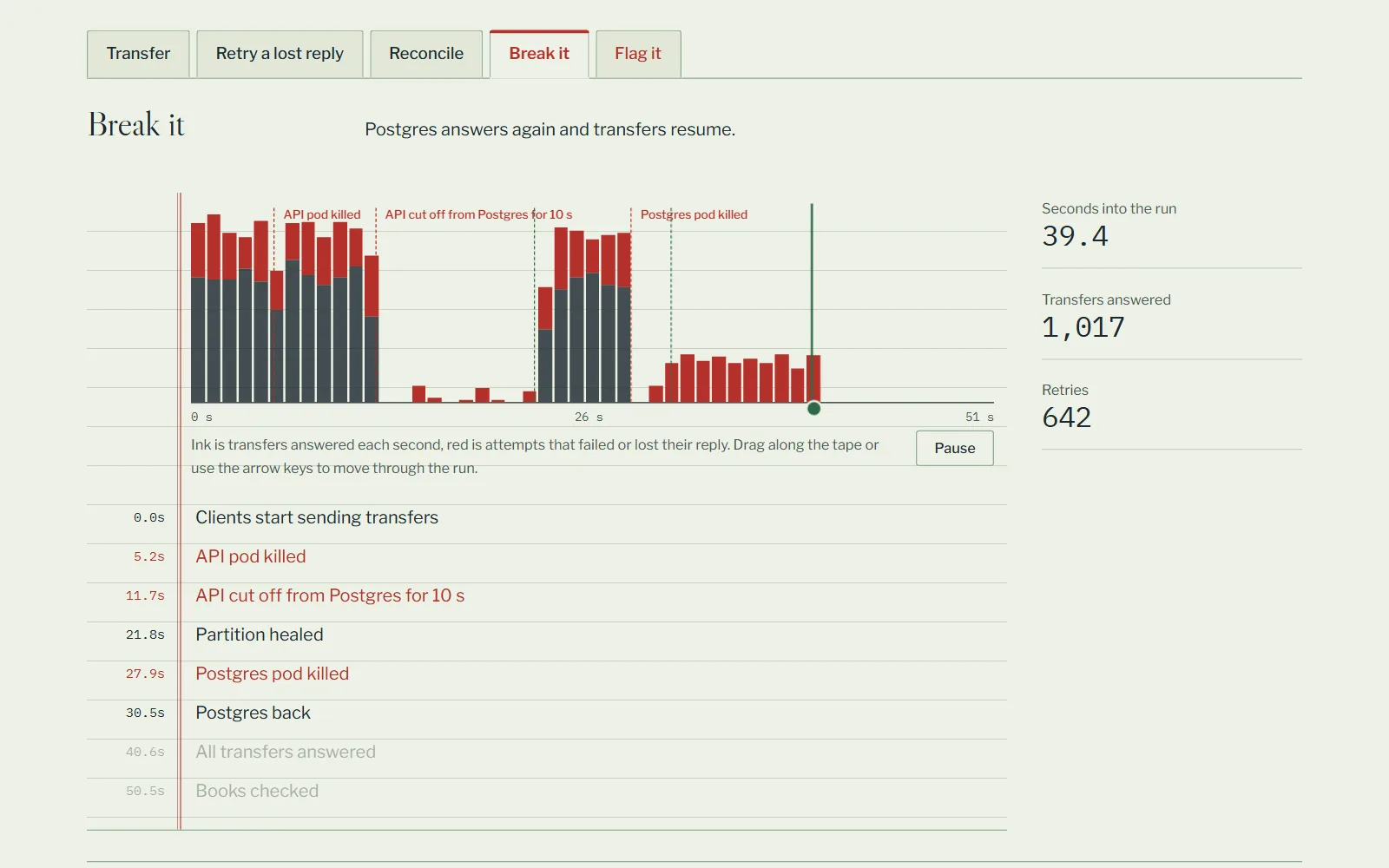
- Transfers pushed through 7 runs on Kubernetes while the network and database were made to fail. Not one cent lost or doubled.
- 11,054none lost
- From the Tally README, fault runs summary line (7 runs, 11,054 transfers and 1,580 retries, 0 violations).
- Of transfers flagged as fraud on data the rules had never seen, 82% really were fraud. The first version managed 37%.
- 0.8179up from 37%
- From the Tally README, fraud table, row Precision / recall on a fresh seed (20260926).
Decisions I made and things that broke
- I locked account rows in one fixed order, so two transfers crossing between the same accounts cannot block each other forever.
- The first failure tests found five real bugs, now each covered by a test. A stale address cache kept the service calling a dead database for a minute.
- Fraud scoring happens after each payment is saved, so a slow or broken scorer can lose a score but never a transfer.
What this proves / 12 skills
AI / ML
- Fraud and anomaly detection
- Of transfers flagged as fraud on new data, 82% really were fraud. The first rules managed 37%.
Systems
- Point-in-time features
- A checker rebuilt 16 fraud signals for all 9,290 payments using only earlier data. It found no mismatches.
- TLA+ and z3
- A TLA+ model follows the transfer code line by line. It passed across about 390,000 distinct states.
- Concurrency
- Account rows are locked in one fixed order, so two crossing transfers can never block each other forever.
- Fault injection
- Transfers kept flowing while the network and database were made to fail. Over about 11,000 transfers, not one cent was lost or doubled.
Web / backend
- Java
- The service is plain Java on the built-in web server, with lightweight threads and hand-written JSON.
- PostgreSQL
- Database rules back the ledger rules. Each payment key is unique, ordinary balances cannot go below zero, and no entry is zero.
- Idempotency
- A payment retried after a lost reply lands exactly once. None of about 1,600 retries was applied twice.
- HTTP APIs
- A small, fixed web API sits over the ledger, with no framework.
Infrastructure
- Kubernetes
- It is deployed to a local Kubernetes cluster from plain config files, and must pass four release checks plus a failure check.
- Observability
- Metrics are hand-written, and speed is timed from when each request was meant to go out, so waiting in line counts.
- Tests and CI
- Automated checks rerun the failure tests on every push as the fifth release check.
The demo, recorded
Papers / 3
- arXiv 2607.05076, Can Code Specify a System Precisely Enough to Formally Verify It?It warned that code and its math model can share one misreading, so real failure tests back up the model.
- arXiv 2608.22389, KONTOGRAPHIt led to a checker that rebuilds every fraud score with later payments hidden, to prove no score used the future.
- arXiv 2609.24446, ActGovEvery new fraud rule is searched by a solver for a case that breaks the stated policies before anyone can turn it on.